
Trust Is Not Built by Data Alone
In real estate development, investment decisions are often described as rational.
Projected returns.
Market demand.
Location advantages.
Growth forecasts.
Yet the reality is far more nuanced.
Even the most experienced investors do not make decisions based solely on numbers. They make decisions based on how confident they feel about their understanding of those numbers.
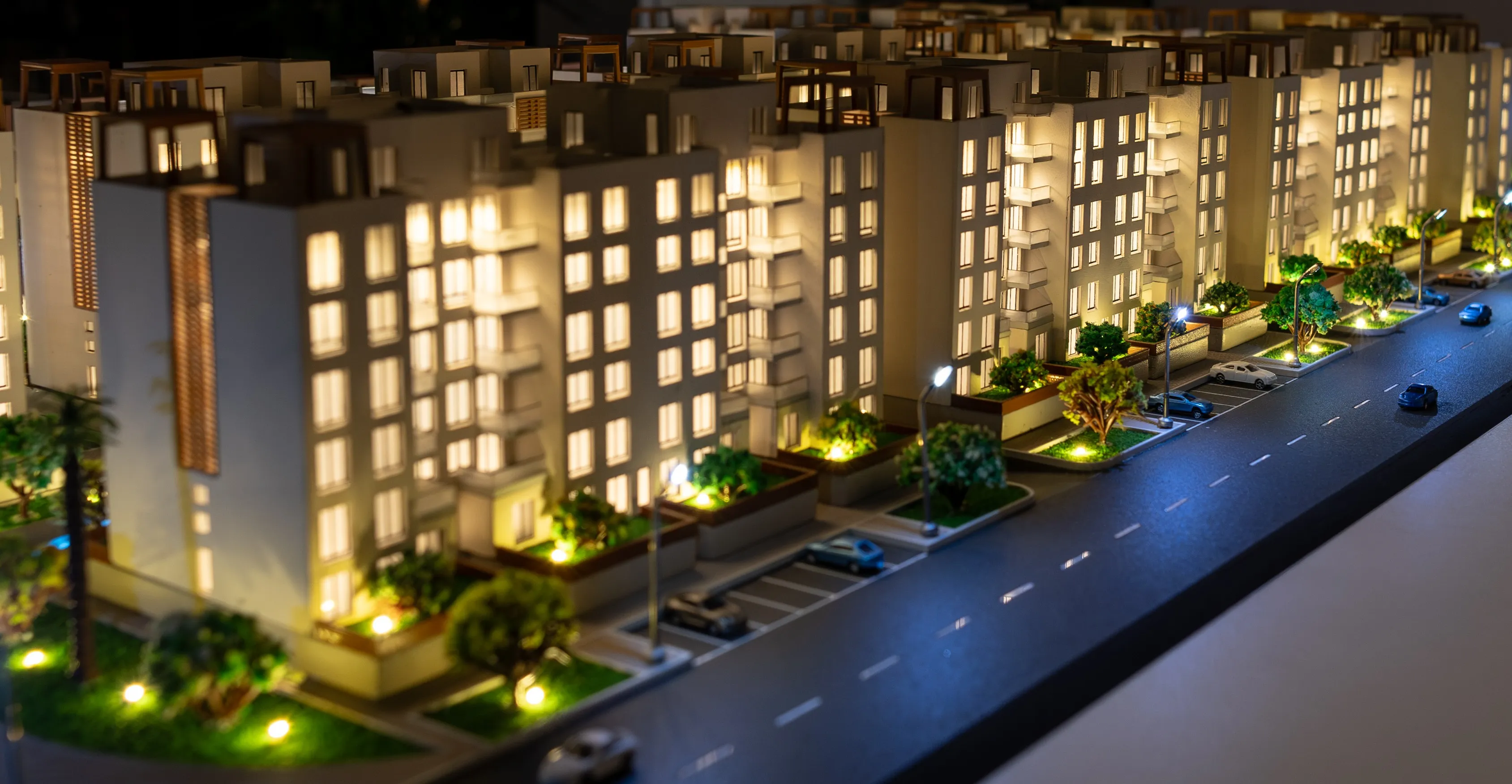
This is why, despite remarkable advances in digital visualization, physical architectural models continue to play a central role in investor presentations around the world.
The question is no longer why physical models still exist.
The real question is:
Why do they continue to inspire more confidence than screens?
Investors Need More Than Information
Today's digital tools are incredibly powerful.
Photorealistic renders.
Virtual reality experiences.
Interactive walkthroughs.
They can showcase every detail of a project with stunning accuracy.
But there is one limitation.
They present the project through a predefined perspective.
A physical model offers something different.
It gives investors the freedom to explore.
To move around the project.
To understand spatial relationships.
To compare building masses.
To grasp scale, density, and connectivity in a way that feels immediate and intuitive.
At that moment, the project stops feeling like a concept and starts feeling like a place.
The Human Brain Is Wired for Physical Understanding
Behavioral psychology provides an interesting explanation.
Long before humans learned to interpret screens, we evolved to understand physical environments.
We instinctively process space, scale, distance, and relationships between objects.
This is why physical models often create a stronger sense of clarity than digital presentations alone.
When investors can physically observe a development from multiple viewpoints, they experience a deeper level of understanding.
And understanding is one of the strongest foundations of trust.
Uncertainty Is the Real Enemy of Investment
People often assume investors fear risk.
In reality, experienced investors know how to evaluate risk.
What they struggle with is uncertainty.
Risk can be measured.
Uncertainty cannot.
When parts of a project remain difficult to visualize or fully comprehend, hesitation naturally follows.
Physical models help eliminate that hesitation.
They transform complexity into clarity.
They allow stakeholders to see the bigger picture while understanding the details.
And when uncertainty decreases, confidence increases.
When Visualization Becomes Confidence
A powerful example can be seen in City Scale's work on the SKY HILLS project.
The objective was not simply to showcase architecture.
It was to help investors and decision-makers understand the development as a complete environment.
How do the buildings interact?
How are public spaces distributed?
How does the overall masterplan function as a living destination rather than a collection of structures?
Once the physical model was introduced, conversations evolved.
Meetings shifted from explaining design concepts to discussing opportunities, value creation, and long-term investment potential.
The model did not merely present the project.
It helped people understand it.
And understanding is what creates confidence.
From Attention to Conviction
Digital presentations are exceptional at capturing attention.
Physical models are exceptional at creating conviction.
And there is a significant difference between the two.
Attention may generate interest.
Conviction drives decisions.
Investors rarely commit to what simply looks impressive.
They commit to what feels understandable, tangible, and trustworthy.
That is why physical models continue to play a critical role in some of the world's most ambitious developments.
The Future of Investor Communication Is Hybrid
The future is not physical versus digital.
It is physical and digital.
The most effective project presentations combine the emotional impact of physical models with the intelligence and interactivity of digital technology.
One creates presence.
The other creates insight.
Together, they create confidence.
And confidence remains one of the most valuable assets in any investment decision.
City Scale: Designing Confidence Through Visualization
At City Scale, we believe architectural models should do more than represent design.
They should simplify complexity, align stakeholders, and strengthen decision-making.
Through thousands of projects across multiple sectors and countries, we have learned a simple truth:
The most effective model is not the most complex.
It is the one that makes a project easiest to understand.
Because investors are not looking for a presentation.
They are looking for confidence in their next decision.