
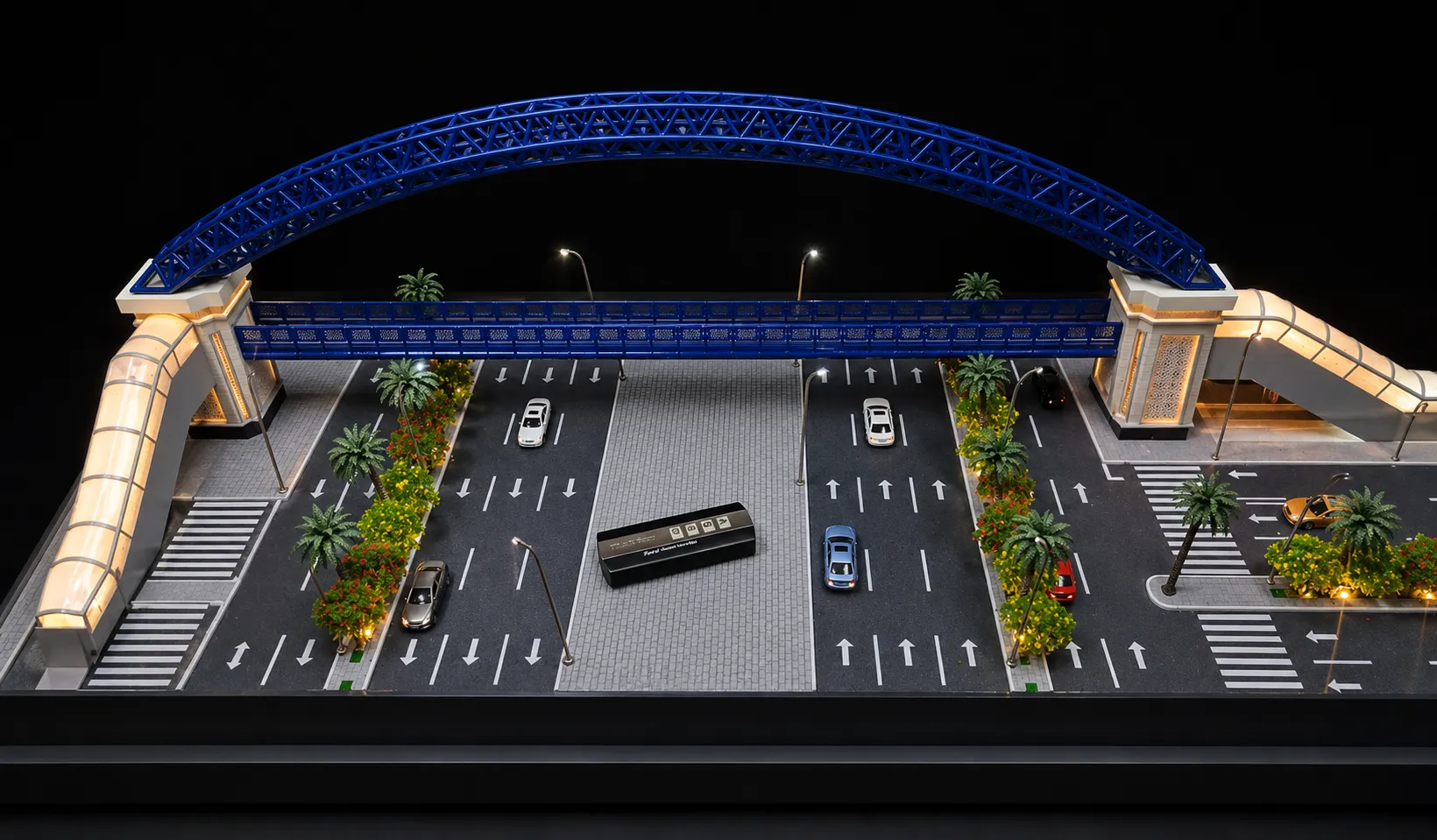
Every city is built twice.
The first version is invisible.
It exists in government meeting rooms, planning authorities, infrastructure workshops, and public consultations.
The second version is built with concrete, steel, and glass.
Most people only notice the second city.
The people responsible for building it know something different.
The most expensive mistakes rarely happen during construction.
They happen long before the first foundation is poured.
Cities Don't Fail Because of Bad Plans.
They Fail Because of Different Interpretations.
Urban planning has never been a shortage of expertise.
Architects understand architecture.
Engineers understand infrastructure.
Transport specialists understand mobility.
Government officials understand policy.
The challenge begins when every expert understands the project differently.
A drawing may be technically accurate.
A presentation may be visually stunning.
Yet each stakeholder can leave the room with a different interpretation of the same future.
For governments, that isn't a communication problem.
It's a governance problem.
The Cost of Misalignment Is Measured in Years.
When urban decisions lack shared understanding, the consequences are rarely immediate.
Projects slow down.
Approvals require additional reviews.
Design revisions multiply.
Budgets grow.
Construction timelines shift.
Public confidence weakens.
These costs don't appear on the first presentation.
They appear years later.
And by then, changing the city is far more expensive than understanding it correctly from the beginning.
Why Governments Still Gather Around Physical Models
Despite AI, digital twins, and immersive visualization, governments around the world continue to rely on physical scale models during strategic planning and public presentations.
Not because technology is insufficient.
Because decision-making is human.
When ministers, planners, engineers, investors, and infrastructure specialists stand around the same model, something changes.
The discussion moves beyond individual perspectives.
People stop debating what they think they see.
They begin making decisions based on a shared understanding.
That shared understanding is often the difference between alignment and delay.
When Vision Becomes Tangible
This principle can be seen in some of the region's most ambitious developments.
During the launch of Hexagon, Saudi Arabia's landmark government data center project, decision-makers were introduced not only to technical specifications and presentations but also to a precision-built physical model that translated scale, infrastructure, and complexity into something everyone in the room could immediately understand.
The model did more than represent the project.
It created a common language between technical experts, government leaders, and stakeholders.
For projects where the future cannot yet be visited, understanding must first be built.
Building Shared Reality Before Construction
At City Scale, every model begins with a different question:
"What must every stakeholder understand before the first decision is made?"
For more than 27 years, across 3,000+ projects in over 30 countries, City Scale has supported governments, developers, and infrastructure leaders by transforming complex plans into shared understanding.
Because cities are not shaped only by engineering.
They are shaped by the quality of the decisions made before construction ever begins.
A city is built with concrete.Its future is built with decisions.